
Planning A Series of Historic American Peg Soldiers
A History of American Interventions?
My first couple of 3D printed peg soldier duos were essentially tests or proof of concept projects as I work out how best to make my peg soldiers now. And everything seemed to work out quite well (mainly because I kept the themes quite simple with very uncomplicated uniform schemes).
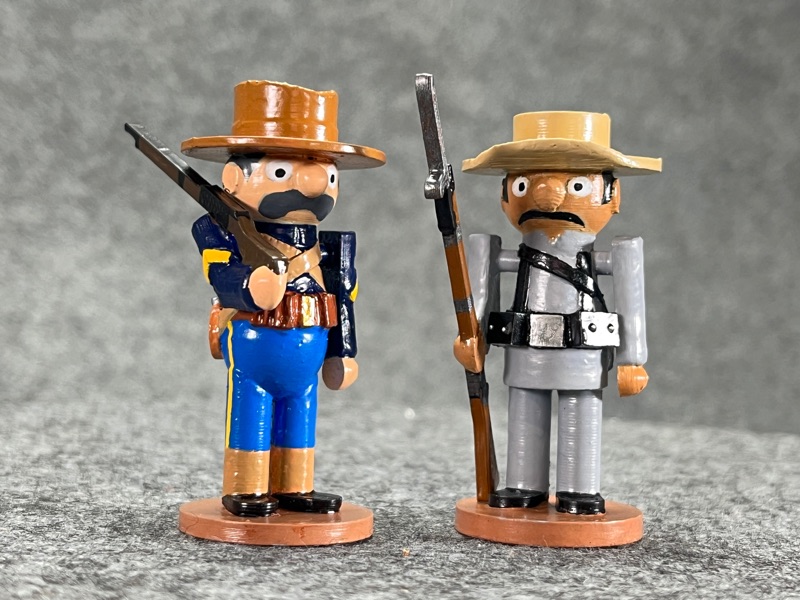 |
| Above: My first duo in my “American Interventions’ series - The Spanish American War. |
Within the subject of 'Little wars', which is mostly centred around mid-to- late 19th century and Edwardian tabletop wargaming, I am currently on a bit of an United States military history binge. While many seem to prefer the wonderfully 'Ruritania'-like fictional European nations or historical European nations on which to base their Little Wars I have developed an interest for what was going on across the pond in America.
For some reason we tend to seem to think that all the 'fun' was going on - militarily - in Europe during the 19th century and also that America kept itself to itself and was not an imperial power. But if you look at American history you begin to see that while it was not overtly seeking of an empire it did actually conduct a lot of what we would describe as 'colonial actions'
 |
| Above: One of America's 'punitive actions' that I thought I might model with my peg soldiers next was the Pancho Villa Expedition. Now known officially in the United States as the Mexican Expedition but originally referred to as the "Punitive Expedition, US Army," was a military operation conducted by the United States Army against the paramilitary forces of Mexican revolutionary Francisco "Pancho" Villa from March 14, 1916, to February 7, 1917, during the Mexican Revolution of 1910–1920. (Source:Wikipedia.) |
And this is what gave me the idea for my current run of peg soldiers - little sets of figures highlighting American's various 'kafuffles', both at home and overseas that in effect were expanding it's influence globally (if not actually creating an empire, but frankly I don't see it was any different to what Britain was doing).
Latest Peg Figure Duo Idea
Anyhoo, having just completed my second duo set and theming them on the Spanish American War of 1898 I started looking for another American dust up to base my next models on. And boy, did I have a lot of choice!
Yes, the Yanks were quietly very busy 'not building an empire' in the most aggressive manner. Whether that be at home with the numerous wars against First Nation peoples or in their 'oops am I invading you' adventures abroad the Yanks were a lot more active campaigning that you might have thought.
Here's a wee list of America exerting it's military force since they so outspokenly broke away form their former 'Imperial' overlords...
The United States has engaged in 36+ major conflicts since its independence in 1775, with sources noting the nation has been at war for approximately 91% of its history.
- American Revolutionary War (1775–1783): Victory securing independence from Great Britain.
- Indian Wars (c. 1785–1890s): A prolonged series of conflicts against Native American tribes; outcomes varied, including U.S. defeats like Red Cloud's War.
- Quasi-War (1798–1800): Undeclared naval war with France.
- First Barbary War (1801–1805): Conflict against Barbary pirates in North Africa.
- War of 1812 (1812–1815): Inconclusive/Status Quo against Great Britain.
- Second Barbary War (1815): Victory against Barbary pirates.
- Mexican-American War (1846–1848): U.S. Victory, resulting in the acquisition of significant western territories.
- American Civil War (1861–1865): Union Victory, ending slavery and preserving the nation.
- Spanish-American War (1898): U.S. Victory, leading to the acquisition of Puerto Rico, Guam, and the Philippines.
- Philippine-American War (1899–1902): U.S. Victory against Philippine independence forces.
Now, as you can see, I have plenty to chose from when trying to pick a set of uniforms depicting American 'non-imperialism' and initially I did have my eye on the Mexican American punch up, but I accidently goes side tracked by another little American adventure...
The Fenian Raids of 1866
Now, straight off the bat you might say 'but Steve, the Fenian Raids weren't an 'American' military campaign'! And, technically, you would be correct, as the US Government 'did not sanction these raids into British territory and proclaimed their neutrality'.... Wink, wink.
The Fenian Raids of 1866 were a series of armed incursions into British North America (now Canada) by the Fenian Brotherhood, an Irish-American organization of Civil War veterans. Their goal was to capture Canada and hold it hostage to pressure Great Britain into granting Irish independence.
Now, I cannot be sure that my intimation that the US were sneakily more than 'passively' involved in these invasions of British Canada, but I do not think anyone would disagree that the certain members of US government were - shall we say - 'happy' with the Fenian raids behind closed doors...
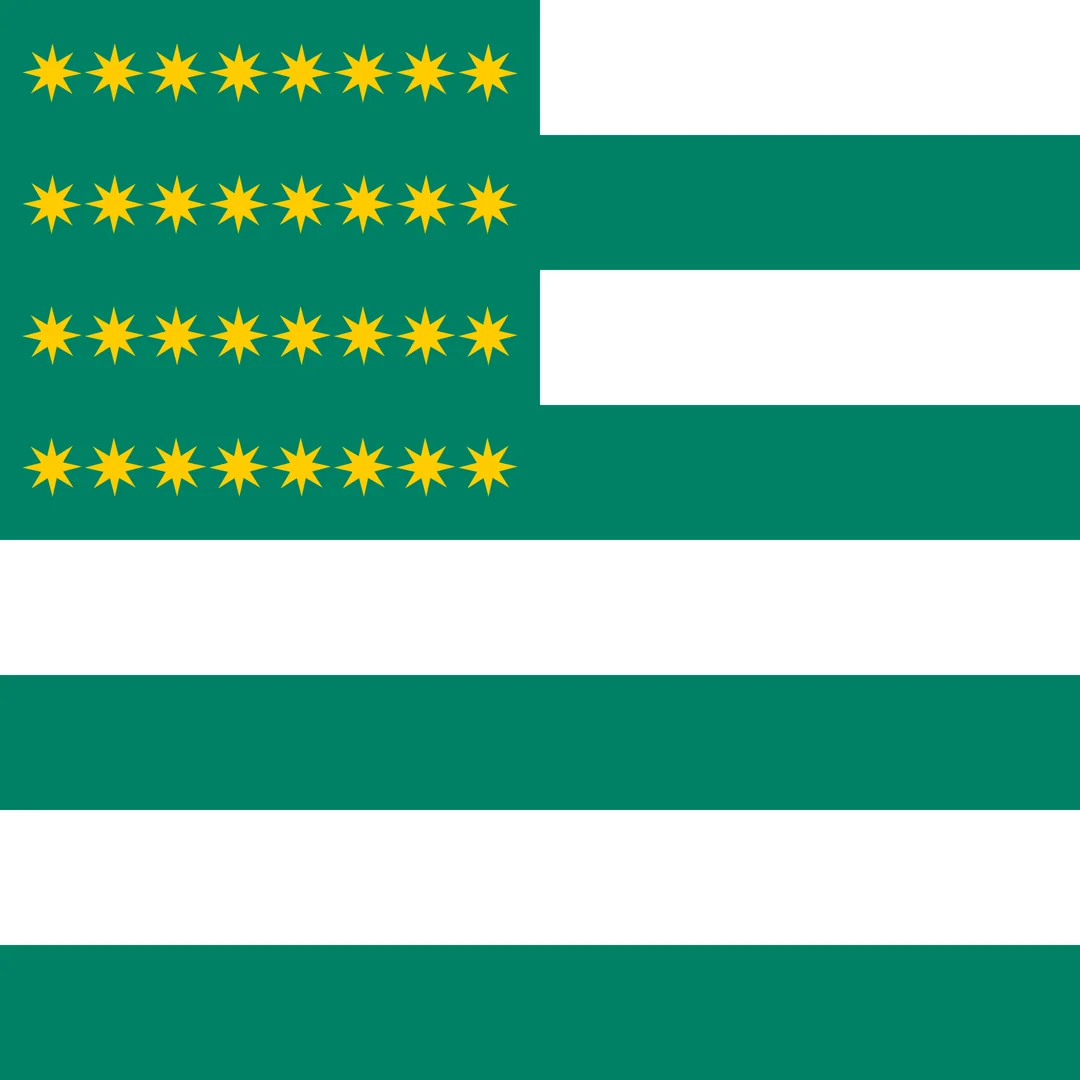 |
| Above: The Fenian Stars and Stripes! No American influence here then? No, none at all. <Smirk.> |
I would be very interested to find out where the money came from to fund these raids, the men and equipment and cannot believe that a whole army just miraculously appeared in the US without someone high up in the US government being aware of it... But this is just my opinion.
So I am going out on a limb and chalking the Fenian Raids down to American propensity for FAFO (F*** Around & Find Out). You are free to disagree.
Designing My Next Peg Soldier Duo
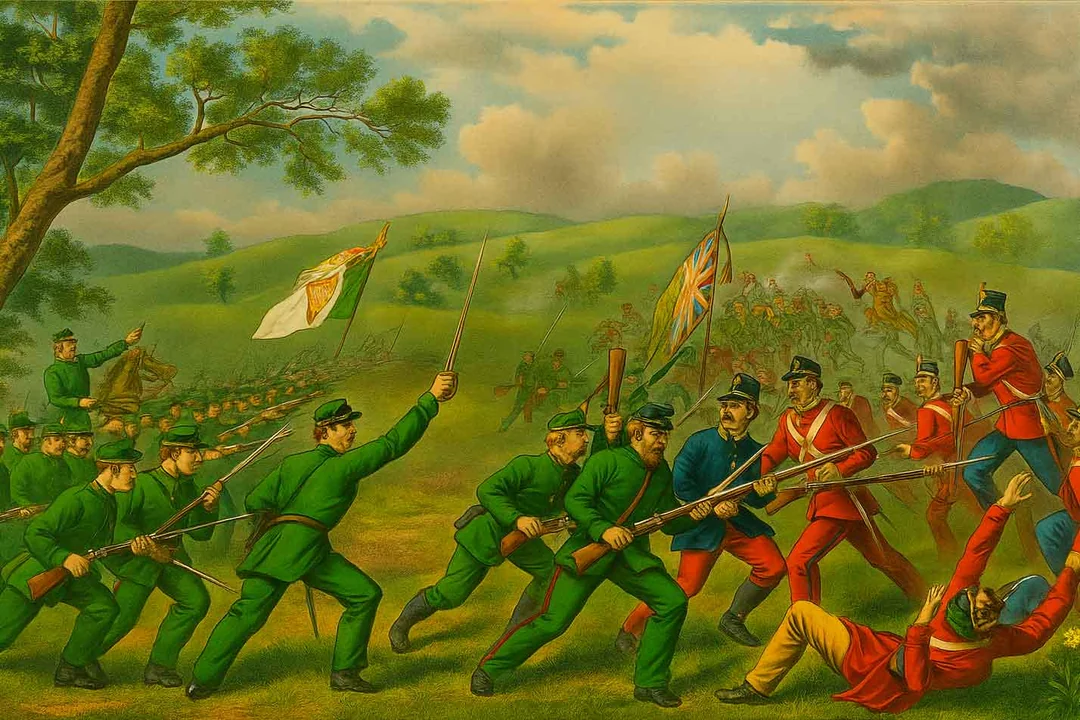
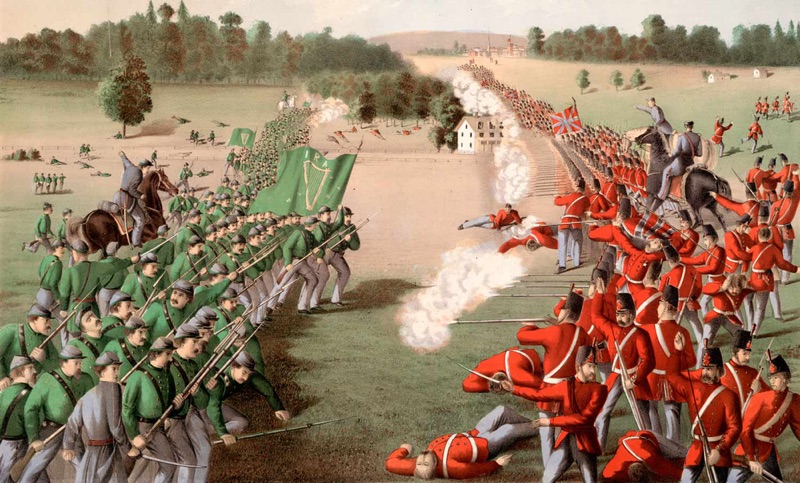
While the Fenian raids might be thought of as a pretty inconsequential speck of history and overlooked by many, it did give us quite a striking uniform that represents Irish Nationalism. However one feels about the Irish struggle the green jacketed dress feature in some of the paintings I have included is very striking and it’s what drew me to this particular subject.
Truth be told, the idea that the Fenian troops were so well equipped may be something of a romanticised notion, in actual fact they were probably mostly a rag tag body of men dressed in varying degrees of uniformity. Rather like the Confederacy, many of the Fenian troops may have only sported token elements of the ideal uniform…
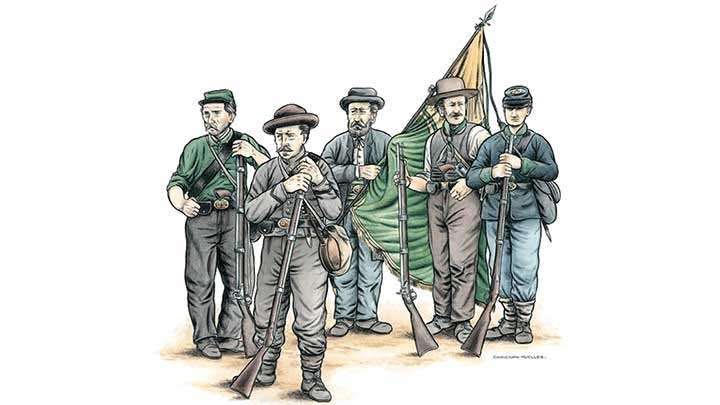
That said, I will lean towards a full compliment of uniform items, simply as a representation of the Fenian movement rather than the reality in the field.
OK, but while the Fenian side of thing might be somewhat tentative there is no question about the uniforms of the British Canadian units. As you might imagine, being under British rule, Canadian forces during the period of the raids was pretty uniform (pun intended). 😏 And was principally of the famous 'Red Coat' variety...
 |
| Above: Memorial party representing the Royal Hamilton Light Infantry who fought at Ridgeway (June 2nd, 1866 resulting in a Fenian victory) as the 13th Battalion. |

Having got some reference on the combatants it was time to start drawing up some sketches of how my peg duo would look.
I am trying out a new way of creating my initial concept sketches due to my issues regarding my 'wobbly hand'. Drawing is now somewhat problematic due to my stroke, so to help me along - and speed things up (I can still doodle, of sorts, but I now have to really take my time which is not conducive to my needs for quick visualisations of project ideas) - I have taken to using AI apps to do the donkey work.
Obviously, using AI is a bit of a maligned shortcut but you still have to have some creative talent to guide it successfully. I also help the AI along by adding what rough doodles I can do and photo edit work as I go along combining bits of my stuff with bits that the AI has generated until - eventually - I come up with a satisfactory hybrid design.
I began by uploading a couple of peg soldier 'blank' models to Google Gemini and then working the descriptive prompts to generate my sketch visuals...
 |
| Above: A screenshot from my TINKERCAD 3D model of my Fenian peg soldier. |

The thing I like about using AI apps like Gemini is that I can quickly work through the initial concept stages of design, easily producing a selection of alternative visuals. Something that consumes a lot of valuable time when done by hand. AI also allows you to try out variations in style...

The output generated by Gemini was interesting as it added little details itself that I had not thought of because I was pretty specific in my requirements including as much background information as I could. For example, having told Gemini that I wanted it to 'dress' my blanks in the uniforms of either side in the Fenian Raids of 1866 note that it added - from it's own research - the Irish Harp emblem on the Fenian.
Now, these are just starting points. In the modelling stage I will expand on these sketches by adding extra accessories, like webbing straps and additional belt work equipment. I will also simplify some of the small detail that I feel I might not be able to paint due to my hand issues - like the neat piping around the collars, we shall see.
Post a Comment